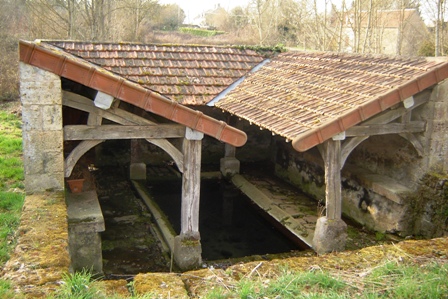
 Click the photo of a Lavoir to see an album of photos. To return to our website, close the window. |
|
Click the photo of a Lavoir to see an album of photos. To return to our website, close the window. |
|
March 2009 The Burgundy area is an easy
three hour car ride from Paris. There are ancient towns to visit and
wines to taste. We didn’t visit any of the famous wineries in the area
but we did sample some good Burgundies with our meals.
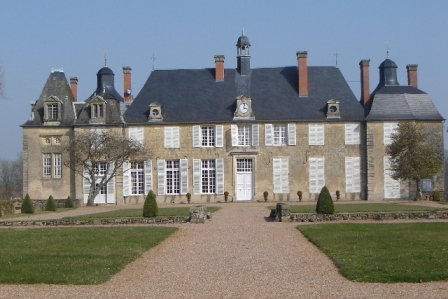
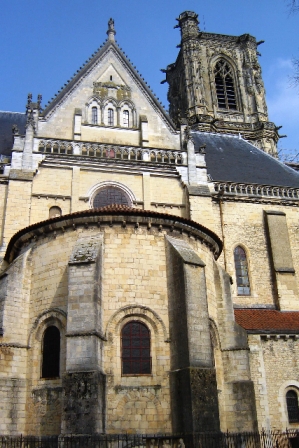
Sunday we took a drive to visit several of the picturesque towns within a short drive from the farmhouse. It seems that every large town has a château, often built as the summer residence of the local Duke. We drove to the tiny town of Arthel for a walk around a dammed lake, complete with a lavoir beside the water. Arthel had two châteaus, one built in the 11th C, the other from the 17th C. Both are still in use. The older one had a tennis court in the yard while horses wandered the fields around the newer one. We made another stop at the Butte de Montenoison with ruins of a 13th C château at the top of and a commanding view of the countryside. Erica and Atticus had to return to Paris on Sunday. Ray and I were to stay at the farmhouse for another two days. We drove to Nevers, about 45 minutes from Thory, where Erica and Atticus would take the afternoon train back to Paris. Nevers, on the right bank of the Loire River, is very quiet on a Sunday. Nearly all the stores were closed and we had to search to find a restaurants open. Nevers is known for its faïence style pottery, introduced by the Duke of Nevers, an Italian, in the 17th C. We had the decision to buy some of the items displayed in several stores made for us as everything was closed. After lunch we said our goodbyes and went to visit the Cathedral Saint-Cyr et Sainte Julitte. This large stone building, built between the 11th and 16th C, is a mixture of Romanesque and Gothic architecture. The church, instead of ironworks nearby, was bombed accidentally by the British in 1944 and sustained extensive damage. The beautiful stained glass windows were shattered but the bombing uncovered a 6th C Bapistry. The church was rebuilt and the windows were replaced in the 1960s with those of contemporary design.
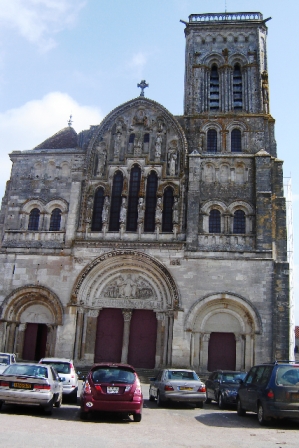
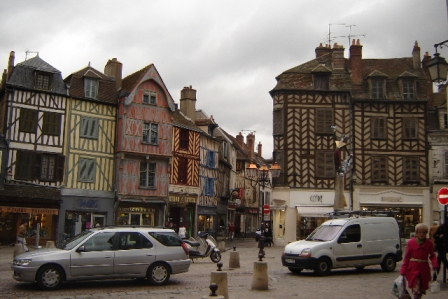
Our destination Monday was Vézelay, a Romanesque town built on a hilltop and designated a UNESCO World Heritage site. At the top of the hill sits the Basilica of Ste Marie-Madeleine. It was founded as a monastery in 878 and was a major pilgrimage destination for adherents coming to view relics of Christ’s disciple Mary Magdalene. The site was also a stopover for pilgrims from Northern Europe on the way to the Camino Santiago de Compostela. Like the cathedral in Nevers, the Basilica is part Romanesque and part Gothic architecture. Most interesting were the detailed stone carvings over doors and on the capitals of the many pillars within the church. Outside we enjoyed the view from a good panorama at the rear of church. By the time we had toured the Basilica it was time for lunch and as usual, the locals know where the best values are found. We had to wait for a table to be available but it was worth the wait. Fortunately the waiter spoke good English as he was able to explain the unfamiliar dishes on the menu and steer us away from the local specialties not palatable to our bland North American tastes. We enjoyed our eventual choices. We had time on our drive back to Paris on Tuesday for a stop in Auxerre. Auxerre, on left bank of Yonne River, has been a thriving commercial center since the Gallo-Roman era and still has a thriving farmer’s market, now located above convenient underground parking. We walked from the market through the old town past numerous half-timbered buildings centered around small squares.
We were headed to yet another
church, Cathedral Saint Étienne. Its flamboyant 13th-14th C Gothic
facade was partially damaged in the 16th C by clashes with Protestant
reformers but it was not destroyed. The beautiful red and blue stained
glass windows from 13th and 16th C retain their appeal. The Cathedral
was visited by Jeanne D'Arc on her was to Orleans in 1430. I had to stop
to take a photo of a statue and stained glass windows installed to
commemorate my namesake |
Return to France Intro Page
Return to Travels
Return to Introduction
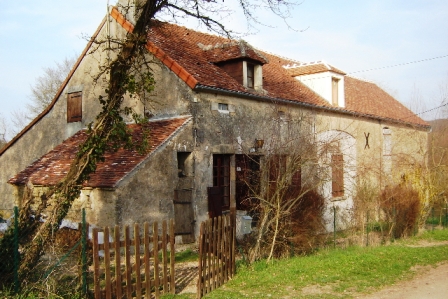 Andrew stayed in Paris with
Roman while Ray, Erica, Atticus and I took the auto route out of Paris
on a bright but chilly Saturday morning in a rented car. Libby and
Spenser Wilson, friends of Erica and Andrew, kindly allowed us the use
of their farmhouse in Burgundy. We stopped on the way to load up with
groceries and soon found our way to the tiny crossroads village of Thory.
Erica and Andrew had visited twice in the summer with their boys but
March is a lot colder and an old stone farmhouse takes a long time to
warm up. We lit the wood stove in the living room and turned on the
space heaters to take the chill out of the rooms.
Andrew stayed in Paris with
Roman while Ray, Erica, Atticus and I took the auto route out of Paris
on a bright but chilly Saturday morning in a rented car. Libby and
Spenser Wilson, friends of Erica and Andrew, kindly allowed us the use
of their farmhouse in Burgundy. We stopped on the way to load up with
groceries and soon found our way to the tiny crossroads village of Thory.
Erica and Andrew had visited twice in the summer with their boys but
March is a lot colder and an old stone farmhouse takes a long time to
warm up. We lit the wood stove in the living room and turned on the
space heaters to take the chill out of the rooms.