|
3 February - 3 March 2008
Siquijor Island, near Bohol, is
another recommended dive spot with opportunities for snorkeling. We
reached it on a 1 ½ hour boat ride from Tagbilaron. We shared a tricycle
from the dock with a French couple who were going to Norwegian Dream
resort. I had tried without success to reserve a room at a resort near
Sandugan, at the north end of the island. There were a few more hotels
near Sandugan, so we instructed the tricycle driver, Romeo, to carry on.
We tried all the hotels at the north but they were all full.
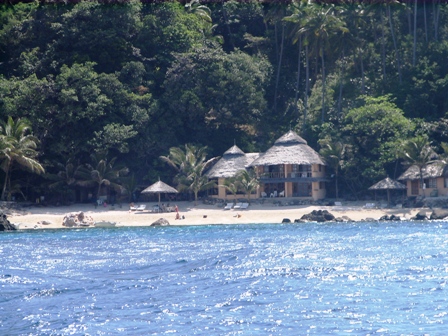
Discouraged, we returned to Norwegian Dream and booked in. The resort
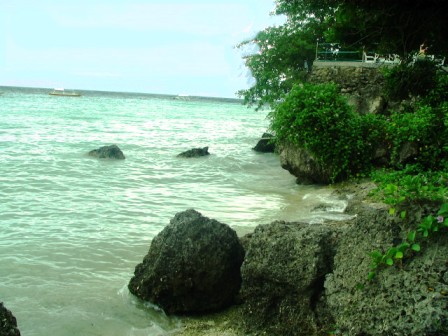
was quite nice but the beach was very rocky and the reef was not close.
Our tricycle driver Romeo
suggested another resort, Royal Cliff Resort near San Juan, on the
opposite side of the island with a cabin available the next morning. As
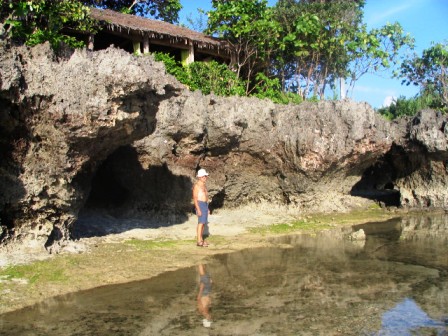
its name suggests, Rocky Cliff, with just six rooms, is on top of a 10 M
cliff with sets of concrete steps leading down to a tiny beach.
Sunbathing, enjoying the view or relaxing was on chairs set out on
several pleasant patios at the top of the cliff rather than on a sandy
beach. Guests tend to return year after year and stay for extended
periods, attracted to the excellent meals and quiet ambience provided by
the German owner and his chef trained Filipipna wife who own the resort.
We discovered very good snorkeling on a reef just 10 M from shore. Ray
saw a banded sea snake, only dangerous if you step on it, and turtles do
swim nearby. We spent our time swimming, walking along the beach at low
tide, and walking to the market in the small town of San Juan.
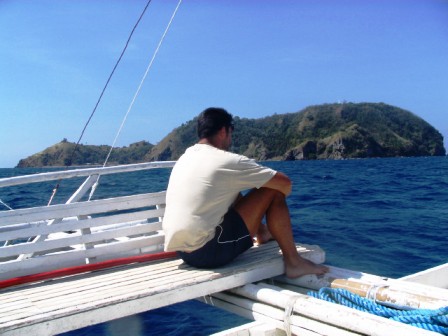
Six of the guests took a day trip by boat to Apo Island, a tiny island
off the coast of Negros Island. There are very few hotels on the island
and when I had inquired earlier, they were fully booked. Instead we took
advantage of our day visit. The island lived up to its reputation of
having some of the best diving and snorkeling around. We all spent our
time at the Fish Sanctuary, reputed to be one of the best in the
Philippines. A highlight for us was discovering a Green Sea Turtle
feeding on the corals just a meter or two above where we were swimming.
We followed it carefully for quite a while and had the thrill of
watching it surface for air just a few feet from us. Another guest from
Royal Cliff, Heidi, who is from Vancouver Island, has stayed at Royal
Cliff each of six years but this was her first visit to Apo Island. She
vowed to return again, this time to dive.
Our last days on Siquijor were progressively rainy but still allowed
time for swimming. Therefore we were not surprised that when it came
time for us to leave on the boat to Dumaguete on Negros Island, we ran
into rain. Dumaguete is a University Town with a busy shopping area. We
had hoped to hike into the mountains nearby to visit Twin Lakes but this
was not an activity for a rainy day. We left after just one night.
Our trip to Moalboal on Cebu
Island was accomplished in the rain but it had stopped by the time we
reached Panagsama Beach, a dive resort about 3.5 km from the fishing
village of Moalboal. The beach was washed away by a typhoon several
years ago, leaving a rocky bottom, but the reef, just 30 m offshore, is
easily reached by swimmers. We managed one good snorkel off the reef
before the weather deteriorated further. At least we had a pleasant
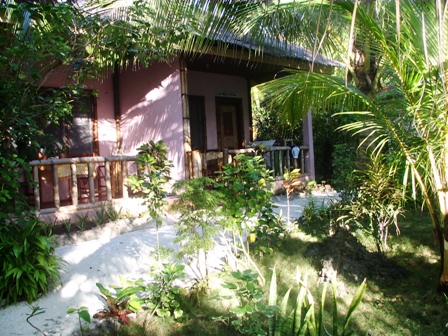
cabin in which to wait out the weather. At Mollie's Place we had a
traditional wooden cabin with a large covered balcony and attached
bathroom. The pipes bringing water from Moalboal to the beach had broken
so we had to make do with a bucket shower and toilet but we didn’t mind.
The temperature was still warm despite the rain and the price was
reduced for the circumstances.
We checked the weather forecast
on the Internet and it was bad all over. A low pressure system was
stalled over the Philippines causing rain everywhere. There was no
better place to move to. The divers did not
seem to mind the weather. They went out on the boats regardless, less
affected by the surface weather. We spent our days reading, going for
walks whenever it cleared, and the last few days when it cleared for
part of the day, swam to the reef to snorkel. We even managed another
turtle encounter and Ray had another banded snake sighting.
We had reserved the last ten days of our trip to explore the mountains
of Northern Luzon, north of Manila. Our first stop was to be Baguio City
to discover why, whenever we gave our name anywhere in the Philippines,
everyone knew how to spell Burnham and mentioned Baguio City. At the
beginning of the 20th century Daniel Burnham, an American Architect and
Urban Planner who planned the rebuilding of Chicago after the famous
fire of 1871, was invited to the Philippines. He created a plan for
Manila that remained incomplete except for Roxas Blvd, a wide boulevard
and promenade bordering
Manilla Bay. More successful was Baguio City, high in the hills north of
Manila. Baguio is called the "Summer Capitol" of the Philippines because
of its temperate climate. Burnham's specialty was designing cities with
road systems to minimize traffic and to include lots of parks and green
spaces. We visited our daughter Erica several years ago when she was
working in Chicago and discovered in a biography that Daniel Burnham had
the same antecedents, four brothers who came to America in the 17th
century, as Ray's family in New Brunswick.
We flew from Cebu to Clark
Airbase, about 1 1/2 hours north of Manila and took a bus north through
the mountains to Baguio City. Baguio sprawls over several mountainsides
resulting in steep climbs no matter where you go in the city. Baguio is
the university center for Northern Luzon and appears to be quite
prosperous. The main shopping area, the restaurants and the markets were
crowded all day and into the evening with customers.
We stayed at the Burnham Hotel, an old traditional hotel that is showing
its age. With its walls of dark native wood and displays of indigenous
crafts, it still retains some charm and our welcome was warm. Of course
we went to the very popular Burnham Park, still the centerpiece of the
city. People strolled or rode rented bicycles on the broad avenues,
rented paddle boats on the central lake, bought food and souvenirs from
the concessions and admired the flowers that change with the seasons.
We still had time to visit Tam-Awan,
an artist's colony and reconstructed indigenous village on top of Quezon
Hill. The originator bought Ifugao hill tribe huts from their owners and
rebuilt then on a lovely site with views over Baguio. Staying in a hut
overnight is very popular and all the huts were reserved during our
visit. Native crafts persons are invited to hold seminars and preserve
the disappearing crafts. Each October a delegation of Canadian
Indigenous people, sponsored by the Canadian Embassey, visit Tam-Awan
for a conference on native arts and crafts. The center also showcases
local contemporary artists with revolving installations and exhibits.
Kabayan, a small village in a
remote section of the hills boasted a collection of mummies. We had
crossed the town off our list as being too difficult to get too until we
met David and Fiona Tiffen at the Burnham Hotel. The couple from Britain
had recently finished 18 months in Kathmandu with Volunteer Service
Overseas and was now traveling on their own. They had arranged to be
taken to see the mummies in a jeep with a local guide and were willing
to let us join them.
The next morning we took a taxi
to the bus station intending to take the five hour bus ride to Kabayan.
David started talking to another taxi driver at the bus station who
offered to drive us to Kabayan. Of course it was more expensive, but
with four people sharing the cost and the likelihood of a much shorter
trip, we agreed on his offer. The first half of the three hour trip was
over paved roads but after that it was a bumpy, unpaved road all the
way. We were happy we had taken this option especially after passengers
on the bus arrived nearly three hours after we did. They reported that
the driver had to make several attempts getting up the hills, including
one spot where all the passengers had to get out and walk up an
especially bad section.
The only accommodation in town is the Coop Lodge, run by the village
Cooperative. The local Coop manager, who had served 15 years as the
village mayor, told Ray that most of the Coop profits come from
extending small loans to locals. They have managed to be very successful
with P 25,000,000 under their management. One of the non-money makers is
the Coop Lodge. It costs P200 each to stay there but that doesn’t cover
all their costs but no one else has offered alternative accommodation.
There was only one room left so
we, along with three Israeli boys, were relegated to two dorms usually
reserved for visiting Government workers in the Municipal Building. All
accommodation was clean but very simple with shared toilets. Our meals,
simple and well prepared, were provided by the storekeeper next to the
lodge.
We arrived in Kabayan in time to visit the small but excellent museum.
There were photos of the mummies found in the area and explanations of
the preservation methods. These mummies are the only ones in the world
to be preserved with their internal organs intact. As the dying person
breathed their last breath, they were fed a solution of water and salt
to preserve their internal organs and then tied in a seating position on
a chair over a glowing fire and tobacco smoke was blown into the body to
drive out any worms or parasites. For the first week, the body was left
with the family so that relatives could pay their last respects and make
special requests of the dead as it was believed the dead could hear
them. The body was wrapped in leaves and herbs. The whole process could
take up to six months, after which the body was placed in a fetal
position in a wooden coffin and placed in a cave high in the mountains.
This burial method was practiced for at least one thousand years until
the Spanish put an end to it several hundred years ago.
The museum manager suggested we
visit a burial cave in the village of Kabayan. We were directed to the
home of an elderly lady who unlocked a gate leading to a cave in her
backyard. Her late husband had discovered the cave in 1971. It contained
hundreds of disassembled skeletons, found to be between 500 and 1000
years old. The bones were neatly arranged with skulls lined up in one
area and other bones separated according to bone type. We paid our
respects to her husband who reposed in the family crypt next to the cave
and thanked our hostess.
We started out early the next
morning in the back of a jeep with a driver and a local Ibaloi guide,
Albert. The presence of a local guide is required to actually see the
mummies. If none is available, you are just permitted to see wooden
coffins inside a small cave opening. It was a rough ride for more than
two hours up the hill. It was hard going for the jeep as well as it
stalled several times and we had to stop to feed more water to the
radiator to cool it down. We stopped once to visit a huge granite rock
where locals had hand carved caves high above the ground to store
coffins inside. I suspect only the village chiefs would be eligible for
such a difficult burial place.
The two mummy caves we visited
were at about 2300 M altitude, just below the top of the mountain. We
climbed down a steep set of concrete caves to the first cave which
Albert opened and uncovered three coffins for us to see. We recognized a
man, a woman and a five year old child from photos in the museum. They
were very well preserved and you could see tattoo markings on the arms
of the adults. The second cave was just a short distance away. Albert
uncovered just one coffin containing a woman who died before giving
birth to a child. We all found it a fascinating glimpse into the ancient
practices of these people and were not disturbed by the bodies
Our visit concluded, we climbed
back into the jeep to be driven another half hour to the Halsema
highway, the main road between Baguio and points north. We caught a bus
heading for Sagada while David and Fiona returned to Baguio for the
weekend flower festival.
Sagada is a small peaceful mountain town with plenty of opportunities
for walks. That was our intention and we were lucky to get as many walks
in as we did given the rains that continued to haunt us. Our first short
walk led us by the large Episcopal Church and Diocesan offices. Reverend
John Staunton, an American Episcopal Missionary, came to Sagada with his
wife in 1904 after assignments in Manila and Baguio. Together they
established an Episcopal center in the mountains which survives to this
day. His wife Maria started the first medical dispensary on the site of
the present hospital and a school in Sagada. Staunton used his training
as an engineer to start a saw mill, import a printing press and to
design a road link between Sagada and the newly developed Halsema
Highway.
One of the best restaurants in Sagada is Masferré. The walls of the
restaurant display many of the photographs of Edward Masferré, the son
of a Spanish soldier turned farmer and a Filipina woman. Masferré taught
himself photography when he purchased a Kodak Graphex camera in 1933. He
recorded the daily life of the indigenous mountain people and the famous
rice terraces from the 1930s to the 1980s. His work gained international
recognition in the 1980s with several international exhibitions. His
works were bought by the Smithsonian Institute in 1990.
The rain stopped long enough for
us to walk to an excellent viewpoint overlooking the Sagada rice
terraces. The terraces cover the steep mountain sides all over the
region. In this region the farmers get just one crop per year, providing
only enough rice for their own family, with little extra for trade. The
rice is all organically grown with no additions of artificial
fertilizers or pesticides. They are very impressive.
Our second day in Sagada was the
only sunny day we experienced in the mountains. We took advantage of the
good weather to visit a few of the caves in the area. At the south end
of town are the hanging coffins. A huge rock outcrop can be seen from
the road from which are suspended several wooden coffins. A skull and a
thigh bone were propped against one coffin lending an air of
authenticity. Further along the road and down into a valley is the
Lumiang Burial Cave. Inside a wide opening we saw multitudes of small
wooden coffins stacked next to the cave walls.
One of the coffins had a
hole opened on the side from which a skull peeped out, just to insure we
knew what resided in those boxes. It is possible to explore farther into
the cave if you have a guide, ropes and kerosene lamps. We passed two
British men who were starting out on a three hour walk between Lumiang
and Sumiang Cave, further on. We met one of the men later who was quite
thrilled with his experience despite having to squeeze through
impossibly tight spaces and rappel down ropes. We contented ourselves
with the openings of both caves.
The market town of Bontoc is a jeepney terminal on
the route between Sagada and Banaue, our next destination. We arrived in
Bontoc to discover the next jeepney for Banaue didn’t leave for two
hours. A visit to the excellent Bontoc Museum was suggested. The museum
had a large collection of photographs, artifacts and displays of
traditional clothing of the local mountain tribes. One interesting
display highlighted the headhunters of the area who conducted raids on
neighbouring tribes, sometimes just to alieve boredom, as recently as
the early 1900s. Outside was a reconstructed native village to visit.
Banaue, which was raining and cold almost the whole
three days we were there, lived up to its reputation as the coldest
place in the Philippines, although its mountain setting and famous rice
terraces were beautiful. We had to take advantage of the little glimpses
of sun whenever it appeared. The rice terraces are best viewed from
several viewpoints above the town.
Accompanied by a guide, Rachel, we took a tricycle to
the highest point, about 3 km up a steep road. Mud walled terraces,
built up to 2000 years ago, cover the mountains around Banaue, in some
areas reaching 1500 M up the side of the mountains. They say if all the
terraces in Banaue were stretched end to end they would reach half way
around the world.
Farmers still plant and harvest by hand using ancient
methods and use no artificial fertilizers or pesticides to grow their
one crop a year of rice. It was the beginning of the planting season.
All the fields had been plowed and the new rice seedlings were in the
process of being transplanted. The walls of the terraces, some of which
were two or three M high, were being cleared of the weeds and plants
that had gained a stronghold since the harvest last June. Several
elderly men and women dressed in their traditional clothing sat chewing
Betel nut at the viewpoint. Rachel said the betel nut protected them
from the cold temperature and suggested we could photgraph them in
exchange for a small amount of money as they were too old to work in the
rice fields. They posed for us quite fetchingly.
After the photography session we followed Rachel down
300 concrete steps to a river at the bottom of the valley and up about
200 more stairs on the opposite side. The tops of the irrigation canals
bordering the rice terraces were concreted providing a path through the
rice fields. Rachel led us on a three hour walk, ending back in the
village.
Our walking poles came in useful navigating the often very
narrow pathway. We had good views until the clouds descended over the
hills and the rains began again. We seldom wore Gortex rain jackets
during our three months in the Philippines, but they were essential in
Banaue. The bottom half of our walk was “mountains in the mist”. Towards
the bottom we passed several traditional one room wooden homes built on
stilts. Most now sported a galvanized steel roof but a few still had a
peaked thatched roof. Unlike our nuclear family lifestyle the
traditional life emphasizes a communal life. The temperature never falls
below 5 C so most of the activities occur outdoors. The traditional
houses were built close together to foster the community feeling. People
live, eat and sleep together and would be suspicious of anyone demanding
time or space for themselves. Rachel asked two women digging sweet
potatoes in a field if we could have a few to sample. They happily gave
us a few of the white and yellow variety which the restaurant cooked for
our supper.
The next morning the clouds were low obscuring most
of the rice terraces. We hurried out to walk the roads through the
villages in the valley. Wood carvers worked in shops along the road
making wood carvings to be sold in souvenir shops all over the
Philippines. Of course the rains started on our walk and we put on our
rain jackets. Men cleaning the rice terrace walls covered their backs
with a large plastic sheet and continued working. Several women wore
small headdress umbrellas as well as the plastic sheets while they
planted rice seedlings. We walked along increasing muddy roads until we
came to the end of the valley rice terraces before turning back.
Reports of less rain in towns a short distance from
Banaue with equally interesting rice terraces prompted us to arrange a
trip to Hapao. We hired Vincent to drive us in his SUV for the day. A
vehicle with 4WD is essential as very little of the roads to Hapao are
paved and the rains have left deep ruts and mud puddles. It took 1 ½
hours to follow the contours of the mountains to the village of Hapao.
Vincent let us off at the edge of the rice terraces and instructed us to
follow the irrigation channel through the rice terraces. Unlike Banaue,
Hapao terrace walls have stone walls. It is thought they have been in
operation since 650 AD. Hapao is a little lower elevation than Banaue so
the fields had been planted two weeks ago and were lush and green. The
sun was out for a change and we had a pleasant walk through the fields,
pausing to stop to a local grandfather entertaining a small grandson. He
told us this was a rest time for his family as they had finished
planting their rice and were not ready to plant their sweet potatoes
higher in the mountians.
We made it back to the road where Vincent was
waiting to drive us 5 km farther along the road to Hungdoan. We never
did get to see the famous spider web arrangement of their rice terraces
as the pattern is only visible from a helicopter, but we did pass by
spectacular mountainside rice terraces along the way. Plus, we managed
to enjoy most of the day before the rains started.
That was our last day in the mountains. It was time
to return to Manila for our flight to Paris. It was a shock to our
systems to travel from the cold and misty mountains back to the hot,
steamy lowlands. We had a good seafood meal at a harbour
front restaurant
in Manila as our farewell dinner. Our visit to the Philippines was an
unqualified success. After three months we were sad to leave the
Philippines but we were looking forward to visiting our daughter and
grandchildren in Paris and getting back to our friends and family in
Canada.
|